At this year’s NDTA-USTRANSCOM Fall Meeting, contested logistics faced a stress test, and USTRANSCOM asked industry to help identify and close the gaps. Four signals stood out.
The annual NDTA-USTRANSCOM Fall Meeting brought together several thousand defense and commercial logistics leaders to assess the state of the Joint Deployment and Distribution Enterprise (JDDE). Over three days, attendees shared observations from the Middle Eastern conflict, emerging AI-fueled cyber threats, and how to continue planning and preparing for future global crises. This year, “contested logistics” and emerging technologies shaped decision-making.
In his keynote, USTRANSCOM Commander Gen. Randall Reed explained that this year’s theme, “Delivering Hope, Projecting Lethality: Theater to Globe,” was deliberate. Hope, he said, is an expression of uncertainty, and uncertainty exposes a gap that logisticians must fill: “We, as logisticians, deal with uncertainty all the time. And we organize, train and equip ourselves to fill in that gap and replace uncertainty with certainty. And when we do that, we guarantee success.”
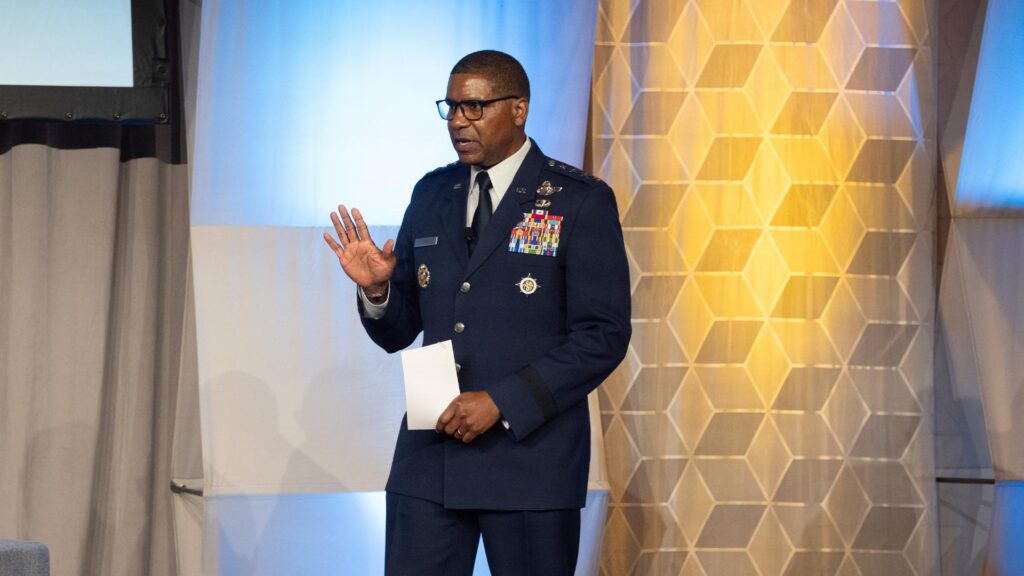
Chairman of the Joint Chiefs Gen. Dan Caine pressed the same point. He urged attendees to “be very creative and entrepreneurial in starting to think about how we’re going to move forces and sustain forces in contact,” in both the physical and information domains.
Having attended many NDTA Fall Meetings, we found this year’s meeting focused, determined, and positive. The conversation centered on commitment to finding solutions that keep pace with near-peer adversaries in an increasingly contested world.
For both of us, it was also something of a homecoming. Garth served at USTRANSCOM from 2006 to 2017 and is the current president of NDTA Florida. Aaron, a retired Navy logistician, has supported the command since 2009. Many of this year’s challenges are familiar, yet the stakes have risen. Here is what stood out.
1. Contested Logistics Is the Baseline, Not the Scenario
In contested logistics, the assumption that U.S. technology and spending power guarantee freedom of movement is gone. Cheap drones and cyberattacks now threaten assets and critical infrastructure. The barrier to entry for adversaries keeps falling. In the future environment, any fixed location is probably at risk.
The Iran conflict offered a proof point. Planners leaned far enough ahead on food, munitions, and supplies to set the theater before conflict. USTRANSCOM leaders credited DoW and industry partners, which move roughly 90% of the cargo and personnel needed in the theater.
Operational impact: The objective is no longer merely moving materiel efficiently. It is sustaining operations despite likely disruption, degradation, and active interference. Readiness now depends on improved mobility, maintaining effective command and control, employing lower-cost, faster-developed solutions, and an industrial base that can respond and retool quickly to address emerging requirements and gaps.
2. Modernization Expands the Attack Surface
The cyber risk that comes with modernization was the less obvious signal. USTRANSCOM’s Joint Transportation Management System (JTMS), the command’s largest modernization effort in years, will connect about 100,000 users across 1,700 locations and consolidate dozens of legacy systems. This ERP solution will improve auditability and deliver mode and route optimization that will reduce costs. It also creates a single, high-value target in an era of escalating, AI-fueled cyber threats.
Cyber risk also extends well beyond IT. Cranes, warehouses, refrigerated storage, and transportation networks are easy to overlook, yet each is a potential target. Because commercial carriers carry most of the load, USTRANSCOM’s cyber posture is only as strong as its partners’. The open question is how the command’s protection requirements will intersect with carriers’ own commercial practices, and who enforces the standard.
Operational impact: In a contested logistics environment, modernization no longer means simply adding capability. It means reducing complexity while improving resilience. Every new connection must strengthen operational outcomes without creating disproportionate risk.
3. The Bottleneck Is Decisions, Not Data
Sensors already sit across the supply chain, yet in-transit visibility (ITV) remains a persistent gap. The problem in contested logistics is turning data into faster decisions, such as rerouting cargo under threat.
NDTA’s Technology Subcommittee, led by our C5MI colleague Marty Groover, worked to address this gap during this year’s NDTA Fall Meeting. As Groover writes in “Closing the Visibility Gap: How Industry Is Helping USTRANSCOM Modernize In-Transit Visibility” (Defense Transportation Journal, October 2026), USTRANSCOM’s strategy is to adopt commercial practice wherever it works and reserve military-unique solutions for the places where it does not. The subcommittee, chartered to advise USTRANSCOM and DLA on commercial practice, set out to show what that looks like.
At the conference, the subcommittee delivered its white paper, “In-Transit Visibility: Industry Best Practices for the Defense Transportation Enterprise,” the product of more than two years of dialogue with USTRANSCOM’s J4/J5/J7 directorate. Its central argument is that visibility is a data product, not a device. Sensing is mature and inexpensive; programs succeed or stall on data architecture, data quality, interoperability, and adoption.
The paper urges organizations to start with the decision that needs to change, fix master data before instrumenting anything, adopt open identifiers and event standards, and manage by exception, with predicted arrival as the headline metric. As the paper puts it, “Visibility that does not change a decision is cost without return.”
Operational impact: End-to-end visibility remains one of the most important enablers of agile logistics across USTRANSCOM and its partners. The discussion at the NDTA Fall Meeting reinforced that progress depends less on collecting more data than on clean master data, open standards, and clear workflows that turn exceptions into decisions.
4. Preparing an AI-Ready Workforce to Act Responsibly
During his fireside chat at the NDTA Fall Meeting, Caine named artificial intelligence (AI), or superintelligence (SI), as one of his top three priorities: “I have sort of three strategic priorities right now, separate from [others]. No. 1 is making sure that we have a budget. … No. 2 is [super intelligence], and No. 3 is ongoing operations. That’s how much emphasis … SI has in transitioning the way that we fight our wars in the future, and it extends across all of the joint functions.”
He further emphasized the importance of “training leaders, systems and models to support future commanders’ decision-making while maintaining appropriate human involvement and balancing the opportunities and risks associated with SI,” according to the Department of War.
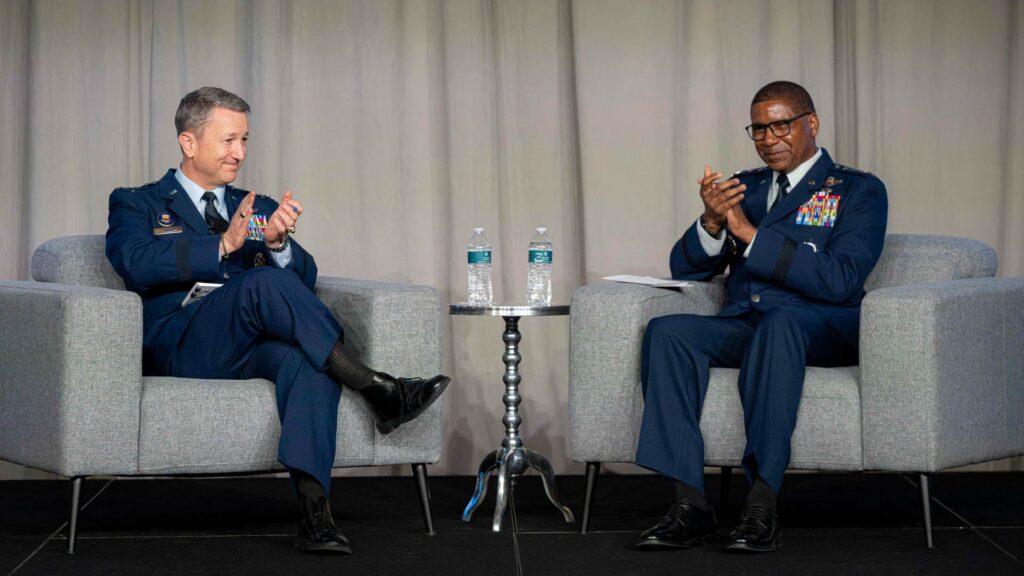
From our perspective, an equally challenging question is the talent pipeline. If AI absorbs more entry-level work, the next generation still needs hands-on experience to serve as the human in the loop and double-check what AI recommends. The large carriers understand that need, and the whole JDDE, including industry, has to keep building that bench of talent.
Operational impact: AI is no longer a future consideration. From autonomous systems to AI-enabled cyber threats and defenses, organizations must learn to integrate AI into decision-making today while building the workforce skills to use it responsibly.
Three Moves for the Next 180 Days
Across keynotes, working groups, and hallway conversations at the NDTA Fall Meeting, these four themes consistently surfaced. Together they suggest that USTRANSCOM is entering a new phase of logistics modernization, one focused less on efficiency and more on resilience, adaptability, and decision superiority.
We need to stress-test our systems and learn to move quickly to be resilient and agile. Here are three ways organizations can prepare for contested logistics now:
- Pick one visibility decision and trace it end to end. Choose a single decision, such as rerouting a shipment under threat. Identify which sensor data could change it and where that data stalls today. Use the subcommittee’s milestone vocabulary and performance targets as a starting point. Then use a commercial solutions opening (CSO) or another adaptive acquisition path to pilot the fix.
- Map the attack surface before JTMS grows it. Inventory the systems and operational technology that will connect to JTMS. Include commercial partners in the review. Decide early what to keep, harden, or sunset.
- Build AI skills alongside AI tools. Train the people who will stay in the loop to question AI outputs, not just accept them. Before automating a process, ask whether the process itself should change. Protect the hands-on roles that develop tomorrow’s judgment.
The Bottom Line
The message from this year’s NDTA Fall Meeting was unmistakable: contested logistics is no longer a future scenario. It is the operating environment. Success will depend on how effectively government and industry combine commercial innovation, resilient systems, and data to inform decision-making.
The good news is that many of the building blocks already exist. The challenge now is scaling them quickly, responsibly, and collaboratively across USTRANSCOM and the broader JDDE.



About C5MI
Trusted across the federal government and commercial sectors, C5MI leads SAP modernization and supply chain transformation. We step in as operators, not just advisors, to solve complex mission and enterprise challenges and deliver measurable results.
Connect with us today to learn how.