NDTA 2026: How USTRANSCOM Will Win in a Contested World

By Aaron Stanley & Garth Sanginiti

Contributor: Marty Groover

Contributor: Marty Groover

At this year’s NDTA-USTRANSCOM Fall Meeting, contested logistics faced a stress test, and USTRANSCOM asked industry to help identify and close the gaps. Four signals stood out.

The annual NDTA-USTRANSCOM Fall Meeting brought together several thousand defense and commercial logistics leaders to assess the state of the Joint Deployment and Distribution Enterprise (JDDE). Over three days, attendees shared observations from the Middle Eastern conflict, emerging AI-fueled cyber threats, and how to continue planning and preparing for future global crises. This year, “contested logistics” and emerging technologies shaped decision-making.

In his keynote, USTRANSCOM Commander Gen. Randall Reed explained that this year’s theme, “Delivering Hope, Projecting Lethality: Theater to Globe,” was deliberate. Hope, he said, is an expression of uncertainty, and uncertainty exposes a gap that logisticians must fill: “We, as logisticians, deal with uncertainty all the time. And we organize, train and equip ourselves to fill in that gap and replace uncertainty with certainty. And when we do that, we guarantee success.”
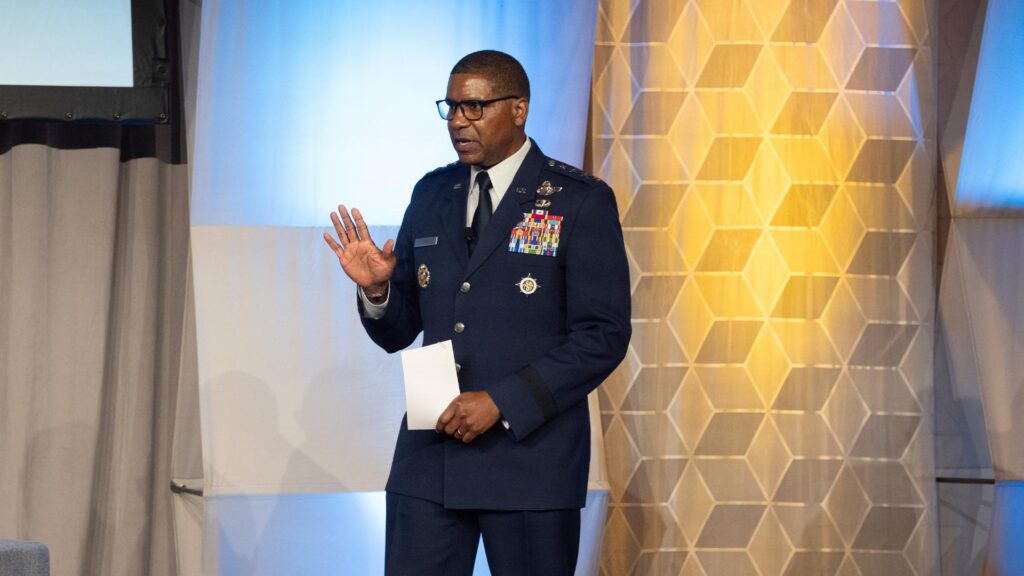
Air Force Gen. Randall Reed, U.S. Transportation Command commander, gestures while speaking on stage at the 2026 NDTA-USTRANSCOM Fall Meeting.
Air Force Gen. Randall Reed, commander of U.S. Transportation Command, speaks at the 2026 NDTA-USTRANSCOM Fall Meeting. (Photo: DVIDS) The appearance of U.S. Department of War (DoW) visual information does not imply or constitute DoW endorsement.

Chairman of the Joint Chiefs Gen. Dan Caine pressed the same point. He urged attendees to “be very creative and entrepreneurial in starting to think about how we’re going to move forces and sustain forces in contact,” in both the physical and information domains.

Having attended many NDTA Fall Meetings, we found this year’s meeting focused, determined, and positive. The conversation centered on commitment to finding solutions that keep pace with near-peer adversaries in an increasingly contested world.

For both of us, it was also something of a homecoming. Garth served at USTRANSCOM from 2006 to 2017 and is the current president of NDTA Florida. Aaron, a retired Navy logistician, has supported the command since 2009. Many of this year’s challenges are familiar, yet the stakes have risen. Here is what stood out.

1. Contested Logistics Is the Baseline, Not the Scenario

In contested logistics, the assumption that U.S. technology and spending power guarantee freedom of movement is gone. Cheap drones and cyberattacks now threaten assets and critical infrastructure. The barrier to entry for adversaries keeps falling. In the future environment, any fixed location is probably at risk.

The Iran conflict offered a proof point. Planners leaned far enough ahead on food, munitions, and supplies to set the theater before conflict. USTRANSCOM leaders credited DoW and industry partners, which move roughly 90% of the cargo and personnel needed in the theater.

Operational impact: The objective is no longer merely moving materiel efficiently. It is sustaining operations despite likely disruption, degradation, and active interference. Readiness now depends on improved mobility, maintaining effective command and control, employing lower-cost, faster-developed solutions, and an industrial base that can respond and retool quickly to address emerging requirements and gaps.

2. Modernization Expands the Attack Surface

The cyber risk that comes with modernization was the less obvious signal. USTRANSCOM’s Joint Transportation Management System (JTMS), the command’s largest modernization effort in years, will connect about 100,000 users across 1,700 locations and consolidate dozens of legacy systems. This ERP solution will improve auditability and deliver mode and route optimization that will reduce costs. It also creates a single, high-value target in an era of escalating, AI-fueled cyber threats.

Cyber risk also extends well beyond IT. Cranes, warehouses, refrigerated storage, and transportation networks are easy to overlook, yet each is a potential target. Because commercial carriers carry most of the load, USTRANSCOM’s cyber posture is only as strong as its partners’. The open question is how the command’s protection requirements will intersect with carriers’ own commercial practices, and who enforces the standard.

Operational impact: In a contested logistics environment, modernization no longer means simply adding capability. It means reducing complexity while improving resilience. Every new connection must strengthen operational outcomes without creating disproportionate risk.

3. The Bottleneck Is Decisions, Not Data

Sensors already sit across the supply chain, yet in-transit visibility (ITV) remains a persistent gap. The problem in contested logistics is turning data into faster decisions, such as rerouting cargo under threat.

NDTA’s Technology Subcommittee, led by our C5MI colleague Marty Groover, worked to address this gap during this year’s NDTA Fall Meeting. As Groover writes in “Closing the Visibility Gap: How Industry Is Helping USTRANSCOM Modernize In-Transit Visibility” (Defense Transportation Journal, October 2026), USTRANSCOM’s strategy is to adopt commercial practice wherever it works and reserve military-unique solutions for the places where it does not. The subcommittee, chartered to advise USTRANSCOM and DLA on commercial practice, set out to show what that looks like.

At the conference, the subcommittee delivered its white paper, “In-Transit Visibility: Industry Best Practices for the Defense Transportation Enterprise,” the product of more than two years of dialogue with USTRANSCOM’s J4/J5/J7 directorate. Its central argument is that visibility is a data product, not a device. Sensing is mature and inexpensive; programs succeed or stall on data architecture, data quality, interoperability, and adoption.

The paper urges organizations to start with the decision that needs to change, fix master data before instrumenting anything, adopt open identifiers and event standards, and manage by exception, with predicted arrival as the headline metric. As the paper puts it, “Visibility that does not change a decision is cost without return.”

Operational impact: End-to-end visibility remains one of the most important enablers of agile logistics across USTRANSCOM and its partners. The discussion at the NDTA Fall Meeting reinforced that progress depends less on collecting more data than on clean master data, open standards, and clear workflows that turn exceptions into decisions.

4. Preparing an AI-Ready Workforce to Act Responsibly

During his fireside chat at the NDTA Fall Meeting, Caine named artificial intelligence (AI), or superintelligence (SI), as one of his top three priorities: “I have sort of three strategic priorities right now, separate from [others]. No. 1 is making sure that we have a budget. … No. 2 is [super intelligence], and No. 3 is ongoing operations. That’s how much emphasis … SI has in transitioning the way that we fight our wars in the future, and it extends across all of the joint functions.”

He further emphasized the importance of “training leaders, systems and models to support future commanders’ decision-making while maintaining appropriate human involvement and balancing the opportunities and risks associated with SI,” according to the Department of War.
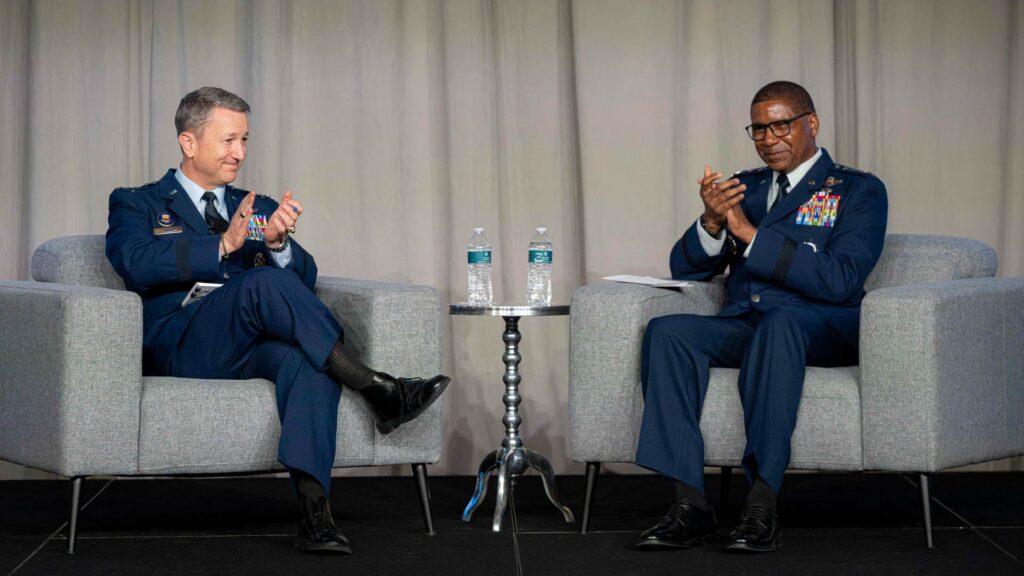
Chairman of the Joint Chiefs Gen. Dan Caine speaks during a fireside chat at the 2026 NDTA-USTRANSCOM Fall Meeting.
Chairman of the Joint Chiefs Gen. Dan Caine speaks during a fireside chat at the 2026 NDTA-USTRANSCOM Fall Meeting. (Photo: DVIDS) The appearance of U.S. Department of War (DoW) visual information does not imply or constitute DoW endorsement.

From our perspective, an equally challenging question is the talent pipeline. If AI absorbs more entry-level work, the next generation still needs hands-on experience to serve as the human in the loop and double-check what AI recommends. The large carriers understand that need, and the whole JDDE, including industry, has to keep building that bench of talent.

Operational impact: AI is no longer a future consideration. From autonomous systems to AI-enabled cyber threats and defenses, organizations must learn to integrate AI into decision-making today while building the workforce skills to use it responsibly.

Three Moves for the Next 180 Days

Across keynotes, working groups, and hallway conversations at the NDTA Fall Meeting, these four themes consistently surfaced. Together they suggest that USTRANSCOM is entering a new phase of logistics modernization, one focused less on efficiency and more on resilience, adaptability, and decision superiority.

We need to stress-test our systems and learn to move quickly to be resilient and agile. Here are three ways organizations can prepare for contested logistics now:

  1. Pick one visibility decision and trace it end to end. Choose a single decision, such as rerouting a shipment under threat. Identify which sensor data could change it and where that data stalls today. Use the subcommittee’s milestone vocabulary and performance targets as a starting point. Then use a commercial solutions opening (CSO) or another adaptive acquisition path to pilot the fix.
  1. Map the attack surface before JTMS grows it. Inventory the systems and operational technology that will connect to JTMS. Include commercial partners in the review. Decide early what to keep, harden, or sunset.
  2. Build AI skills alongside AI tools. Train the people who will stay in the loop to question AI outputs, not just accept them. Before automating a process, ask whether the process itself should change. Protect the hands-on roles that develop tomorrow’s judgment.

The Bottom Line

The message from this year’s NDTA Fall Meeting was unmistakable: contested logistics is no longer a future scenario. It is the operating environment. Success will depend on how effectively government and industry combine commercial innovation, resilient systems, and data to inform decision-making.

The good news is that many of the building blocks already exist. The challenge now is scaling them quickly, responsibly, and collaboratively across USTRANSCOM and the broader JDDE.



  • C5MI Leadership: Aaron Stanley.
    (Author)

    As Client Relationship Executive at C5MI, Aaron Stanley strengthens partnerships with federal and defense clients, applying deep mission insight to align delivery, anticipate evolving needs, and expand the value C5MI provides across each engagement.

  • C5MI Leadership: Garth Sanginiti.
    (Author)

    As Vice President of Business Development at C5MI, Garth drives enterprise growth and federal market expansion, applying deep government insight to build strategic partnerships, grow the pipeline, and align new opportunities with mission priorities.

  • C5MI: Marty Groover
    (Contributor)
    As Managing Director, Pre-Sales at C5MI, Marty leverages his two decades of Navy experience and expertise in production planning, lean manufacturing, and ERP systems to help organizations achieve operational efficiency and innovation.

About C5MI

Trusted across the federal government and commercial sectors, C5MI leads SAP modernization and supply chain transformation. We step in as operators, not just advisors, to solve complex mission and enterprise challenges and deliver measurable results.

Connect with us today to learn how.

We Operationalize IT℠
© 2026, C5MI Insight LLC. All rights reserved.

Download the FREE Resource Today!

Stage 6

Autonomy

The system handles tasks.
The team sets strategy.

Our Process

At full maturity, the supply chain does not wait for human decisions on routine matters. It makes them. Robots execute warehouse tasks, RPA handles transactional processes, and AI optimizes routing, scheduling, and inventory positioning. Goal-driven autonomous execution and dynamic re-tasking keep work moving while people shift from executing to overseeing systems.

Where Organizations Get Stuck

  • Automation investment made but not integrated into a coherent autonomous operating model
  • AI and robotics still deployed in isolated pockets, not connected to a single system-wide decision framework
  • Operations teams still manually executing routine tasks that current technology is fully capable of handling
  • The organization is ready for autonomy but the governance model has not caught up

Our Capabilities At This Stage

Through the Automation Center of Excellence, AI practice, and Industry 4.0 capabilities, C5MI® helps organizations ready for autonomy deploy robotics, RPA, and autonomous execution as one coordinated model, not disconnected tools.

Stage 5

Predictability

Stop reacting to events.
Start managing what is next.

Our Process

This is the shift from reactive to proactive. The organization can see and respond but still reacts afterward. Predictability means the system anticipates what is coming, using predictive scoring, inventory forecasting, and Digital Reliability-Centered Maintenance (DRCM®) to flag demand shifts, supply disruptions, and production risks early. Leaders stop firefighting and start managing forward.

Where Organizations Get Stuck

  • Inventory policy built on historical assumptions rather than forward-looking demand signals
  • Supply disruptions and production shortfalls identified too late to prevent downstream impact
  • Planning cycles still periodic, so the operation adjusts to change rather than anticipating it
  • Working capital and service performance still treated as competing priorities rather than connected ones

Our Capabilities At This Stage

Through Live Warehouse predictive capabilities, inventory forecasting, and DRCM, C5MI® aligns inventory policy and planning with what comes next, shifting leadership from reaction to forward confidence.

Stage 4

Adaptability

You see what is happening.
Now the operation can act.

Our Process

Visibility changes what you know. Adaptability changes what you do with it. With confidence in the data, real-time information moves from observation to action: dynamic tasking, default responses to exceptions, and workforce adjustments made in minutes rather than hours. The operation adapts to live data as it arrives, not to what a shift debrief reveals afterward.

Where Organizations Get Stuck

  • Dashboards exist but supervisors lack the governance structures to act on what they show
  • Responses to exceptions still manual and slow, so the impact compounds before anyone acts
  • Workforce capability inconsistent across sites, with some teams adapting well and others not
  • Improvement at one facility does not travel, and no shared execution model scales responses across the network

Our Capabilities At This Stage

Through the SCAR Workforce Enablement module and Live Warehouse event-driven capabilities, C5MI® gives operations governance and tools to act consistently on live data across every site.

Stage 3

Visibility

The data is in the system.
Now see what is happening.

Our Process

At this point, the integrations are in place and the data is there, but operations cannot see it in real time. Teams still run on lagging reports, periodic system checks, and verbal updates. This stage changes that. Instead of finding out what happened after the fact, you see what is happening as it unfolds, with live status across warehouse, manufacturing, and logistics.

Where Organizations Get Stuck

  • Operational decisions based on reports that are hours old by the time anyone reads them
  • Exceptions and bottlenecks identified only after they have already affected throughput or service
  • Supervisors managing by instinct and experience rather than current operational data
  • The data to manage better exists in the system, but the operation cannot see it in real time

Our Capabilities At This Stage

Through Live Warehouse and the SCAR Live Visibility module, C5MI® turns integrated data into a single version of truth and a common operational picture, giving supervisors and leaders real-time status everywhere.

Stage 2

Integration

The systems are in place.
Now they need to connect.

Our Process

This is where foundational platforms are in place but operating in isolation from one another. IT systems hold transactional data. OT systems, such as sensors, equipment, production lines, and warehouse automation, generate operational data. The two worlds are not connected, so teams still decide with incomplete information, and no one has cross-site visibility.

Where Organizations Get Stuck

  • OT data from warehouse and manufacturing equipment not flowing into SAP® solutions, so teams decide without it
  • System configuration misaligned with actual operational workflows, creating friction and exceptions
  • No visibility across sites, with each facility managing independently and no shared operational picture
  • IT and operations teams solving the same problems separately because their data is not connected

Our Capabilities At This Stage

Through Digital Core integration capabilities and the SCAR EWM Transformation module, C5MI® bridges IT and OT, aligning systems, rationalizing applications, building auditability, and connecting data across sites.

Stage 1

Implementation

You invested in the platform. Now it needs to perform.

Our Process

At this stage, C5MI® builds an adaptive foundation on SAP® solutions, including SAP S/4HANA®, SAP Extended Warehouse Management (SAP EWM), SAP Transportation Management (SAP TM), and SAP Enterprise Asset Management. Most organizations arrive here with the investment made but the performance missing. The gap between what the system promised and what the operation actually gets is where C5MI starts.

Where Organizations Get Stuck

  • SAP S/4HANA, SAP EWM, or SAP TM deployed but not delivering expected throughput or data quality
  • System configuration built for the implementation, not for how the operation actually runs each day
  • Workarounds accumulating as teams adapt to the system rather than the system adapting to them
  • Post-go-live support consumed by firefighting rather than optimization

Our Capabilities At This Stage

By standardizing, operationalizing, sustaining, and remediating SAP Digital Core systems, C5MI delivers the performance organizations invested in and maintains it long after go-live, keeping the operation at its best.

Request SCAR Diagnostic

Let's Connect

Download the FREE Resource Today!

Live Webinar
C5MI is a SAP Partner.
C5MI is a KINEXON Partner.
C5MI Logo.
C5MI is a SAP Partner.
C5MI is a KINEXON Partner.
C5MI Logo.

How to Optimize A&D Intralogistics Operations With Automated Asset Tracking

C5MI Logo.
Privacy Policy

Effective June 28, 2024.

This Privacy Policy tells you how C5MI (“we,” “our,” “us”) collects, uses and shares information we collect on our website www.c5mi.com (“Site”) effective as of the date posted above.  By using the Site and submitting information you agree that we may use and disclose your information according to the terms of this Policy.

Information collected and how it is used.

We automatically collect information when you visit the Site including your device’s IP address, and statistics about how you use the Site.

We collect information that you voluntarily submit when visiting the Site including contact information if contact us with an inquiry (email address, telephone number).  We may offer a Careers page to let you know about job opportunities with us.  This page allows you to submit information relevant to employment including education and employment history.  It is operated by our third party staffing partner who shares the information you submit with us.

We use the collected information for our general commercial purposes such as to improve our Site, grow our business and to offer our own, our affiliates’ or third-party products or services that we think you may find of interest. We use your contact information to respond to your inquiries or to provide information on products or services to you.

We may use cookies and similar technology to collect aggregate (non-personal) information about Site usage by all of our visitors and to help us remember you and your preferences when you revisit the Site. These cookies may stay on your browser into the future until they expire or you delete them. We also may use cookies to aid in the functionality of the Site; these cookies usually are erased when you close your browser window.  Further general information about cookies and how they work is available at allaboutcookies.org.

We may allow selected third parties to place cookies, pixels, or similar technologies through the Site to provide us with better insights into the use of the Site or user demographics or to provide relevant advertising to you.  These third parties may collect information about a consumer’s online activities over time and across different websites when he or she uses our website. We may also permit third party service providers to place cookies through our Site to perform analytic or marketing functions where you are notified of them and you have consented to the usage. We do not control the use of such third party cookies or the resulting information and we are not responsible for any actions or policies of such third parties.

We do not use technology that recognizes a “do-not-track” signal from your web browser.  Our Site is configured to suppress cookies and similar technologies if we detect an IP address or other indication that the visitor is from California.

Children’s Privacy.

This Site is not designed nor intended to be attractive to use by children under the age of 13.  We do not knowingly collect information from children under the age of 13.  If you are under 13 please do not submit any information to us.

Accessing your information and your choices.

You can update, amend or delete information you have provided to us at any time by emailing us at change@c5mi.com.

You can choose not to receive promotional emails from us by “unsubscribing” using the instructions in any email you receive from us.  This will not stop us from sending emails about your transactions with us.

You can choose to delete or block cookies by setting your browser to either reject all cookies or to allow cookies only from selected sites.  If you block cookies performance of the Site may be impaired and certain features may not function at all.

Disclosing your information.

We may reveal information about you to unaffiliated third parties: (1) if you request or authorize it; (2) if the information is provided to help complete a transaction for you; (3) if the information is provided to comply with the law, applicable regulations, governmental and quasi-governmental requests, court orders or subpoenas, to enforce our agreements, or to protect our rights, property or safety or the rights, property or safety of our users or others (e.g., to a consumer reporting agency for fraud protection etc.); (4) if the disclosure is done as part of a purchase, transfer or sale of services or assets (e.g., in the event that substantially all of our assets are acquired by another party, customer information may be one of the transferred assets); (5) if the information is provided to our agents, outside vendors or service providers to perform functions on our behalf (e.g., analyzing data, providing marketing assistance, providing customer service, processing orders, etc.); or (6) as otherwise described in this Privacy Policy.

We may share your information with our affiliated companies.

We do not share your information with third parties for their marketing purposes.

Security.

We use reasonable technical, administrative and physical measures to protect information contained in our system against unauthorized access, destruction, misuse, loss or alteration.  We may use standard encryption technology to protect information being transferred to our site, but no method of electronic transmission or storage is 100% secure.

Data Processing and Cross-Border Data Transfers.

Our Site is maintained on servers located in the United States, and personal information submitted is stored on our servers in the United States.  If you are visiting our Site from outside the United States, please be advised that your information is transferred to our U.S. servers.  Disclosing your personal information to us pursuant to this Privacy Policy is at your own risk.  We strive to comply with laws of jurisdictions in which we maintain operations but we make no representations that the practices described in this Privacy Policy are compliant with laws outside those jurisdictions that apply to the collection, security, use and disclosure of personal information.

Notices to California Residents.

Your California Privacy Rights.  California residents with an established business relationship with us are permitted by California law once a year to request information about the manner in which we shared certain categories of information with others for their marketing purposes during the prior calendar year.

We do not share your personal information with third parties for their direct marketing use.

California Consumer Privacy Act Notice

At this time we are not required to comply with the California Consumer Privacy Act as amended by the California Privacy Rights Act (CCPA). We will update this Privacy Policy when we qualify for coverage under the CCPA.

Notice to Colorado, Connecticut, Florida, Montana, Oregon, Texas, Virginia and Utah Residents.

We are currently not subject to the Colorado Privacy Act, the Connecticut Personal Data Privacy Act, Florida Digital Bill of Rights, the Montana Consumer Data Privacy Act, the Oregon Consumer Privacy Act,  the Texas Data Privacy and Security Act, the Utah Consumer Privacy Act, or the Virginia Consumer Data Protection Act. If we become subject to any of these laws in the future we will update this Privacy Policy accordingly.

Notice to Nevada Residents.

We do not transfer personal information for monetary consideration.  If you would like to tell us not to sell your information in the future please email us at change@c5mi.com with your name, postal address, telephone number and email address with “Nevada do not sell” in the subject line.

Links to other sites.

We may permit others to link to this Site or to post a link to their site on ours.  We do not endorse these sites and are not responsible for other sites or their privacy practices.   Please read their privacy policies before submitting information.

Changes to the Privacy Policy.

From time to time we may amend this Privacy Policy.  The Policy in effect at the time you use the Site governs how we may use your information.  If we make material changes we will post the revised Policy and the revised effective date on this Site. Please check back here from time to time to review any changes.

Contacting us.

This Site is owned and operated by C5MI.  You can contact us by email at change@c5mi.com or write to us at 120 5th St N, Jacksonville Beach, FL 32250.